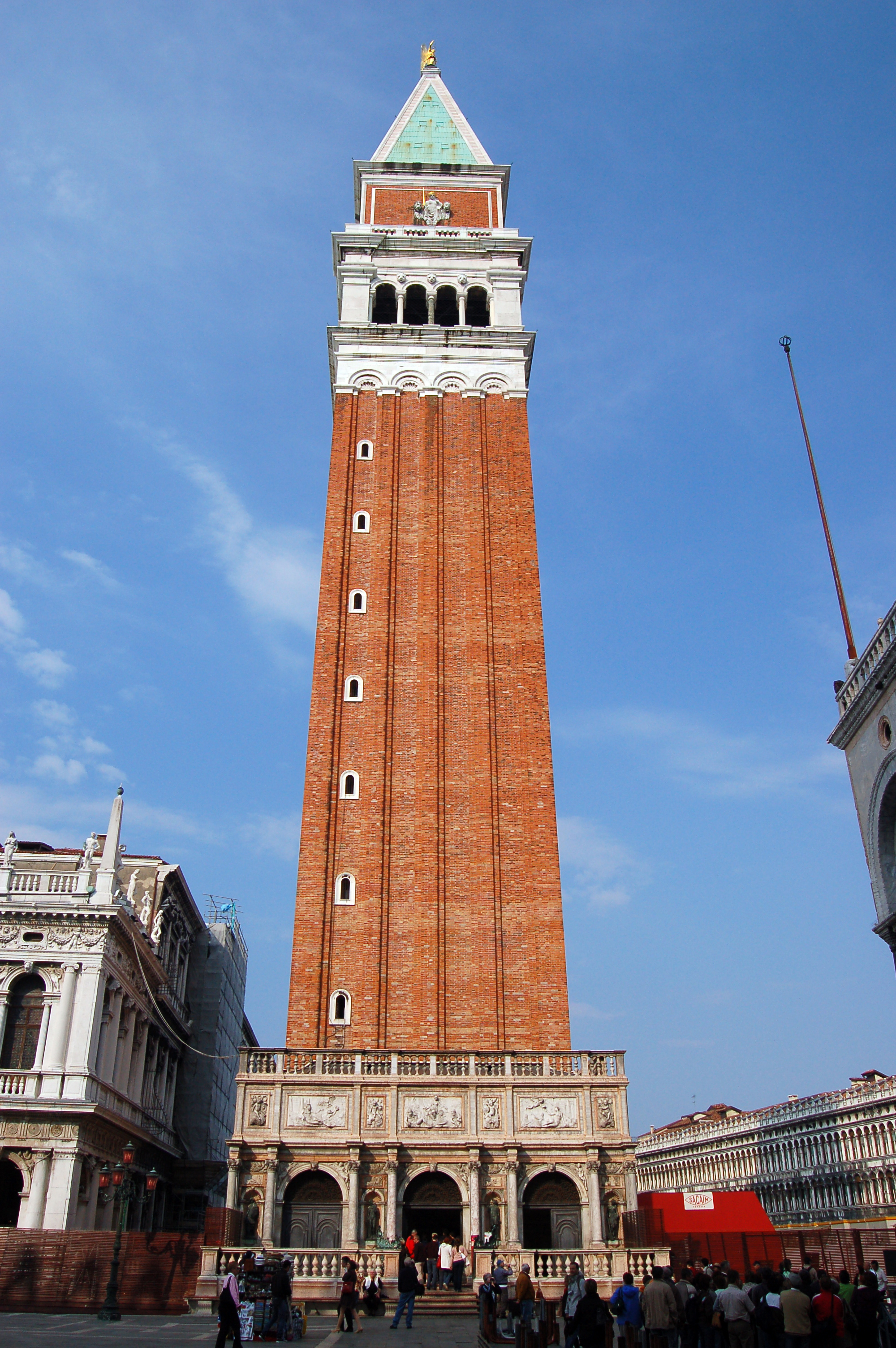
A campanile is a freestanding bell tower built in association with a church or cathedral, though detached from the main building rather than integrated into its fabric. The term derives from the Latin campana (bell) and is specific to Italy — in English-language architectural writing, the word campanile refers almost exclusively to Italian examples. What the word describes, however, is not a single form but a category that encompasses considerable structural and stylistic variation across regions and centuries.
Early towers: Ravenna and the cylindrical tradition
The earliest surviving Italian campanili, dating to the sixth through tenth centuries, are round in plan. The towers of Ravenna — including the campanile of Sant'Apollinare in Classe and the bell tower attached to Sant'Apollinare Nuovo — are the most studied examples. These cylindrical forms were built in plain brick with minimal surface decoration. Window openings are narrow at the base and widen progressively toward the belfry zone, a practical response to the structural requirement for thicker walls lower in the shaft.
The round campanile tradition was not uniform across early medieval Italy but was particularly concentrated in the former Byzantine administrative territories of the northeast and the regions around Rome. In Lombardy and Tuscany, square towers predominated even in early medieval construction.

Lombard campanili: the square shaft elaborated
Lombard Romanesque architecture produced the most immediately recognisable variant of the Italian bell tower: a square-plan shaft rising through several stages, each marked by a horizontal string course, with the belfry stage opening through paired or triple arched windows. The decorative vocabulary includes lesenes — shallow vertical strips that divide the wall surface without carrying structural load — and Lombard bands, which run horizontally between the lesenes at each floor level.
The belfry zone typically carries more elaborate window tracery and in some examples features a short spire or pyramidal roof cap. Towers in Lombardy, Emilia-Romagna, and the Po Valley follow this general pattern while varying considerably in height, proportional emphasis, and the depth of the surface decoration.
Regional brick characteristics
The brick used in Lombard campanile construction varied in size and firing colour across sub-regions. The characteristic red-orange brick of Milan and the Milanese plain contrasts with the darker, more variable brick of the Emilian plain. These material differences were partly the result of local clay deposits and partly of distinct firing traditions in regional kilns. The structural performance of the bricks was broadly similar; the visual effect was not.
Florentine campanili: polychrome marble cladding
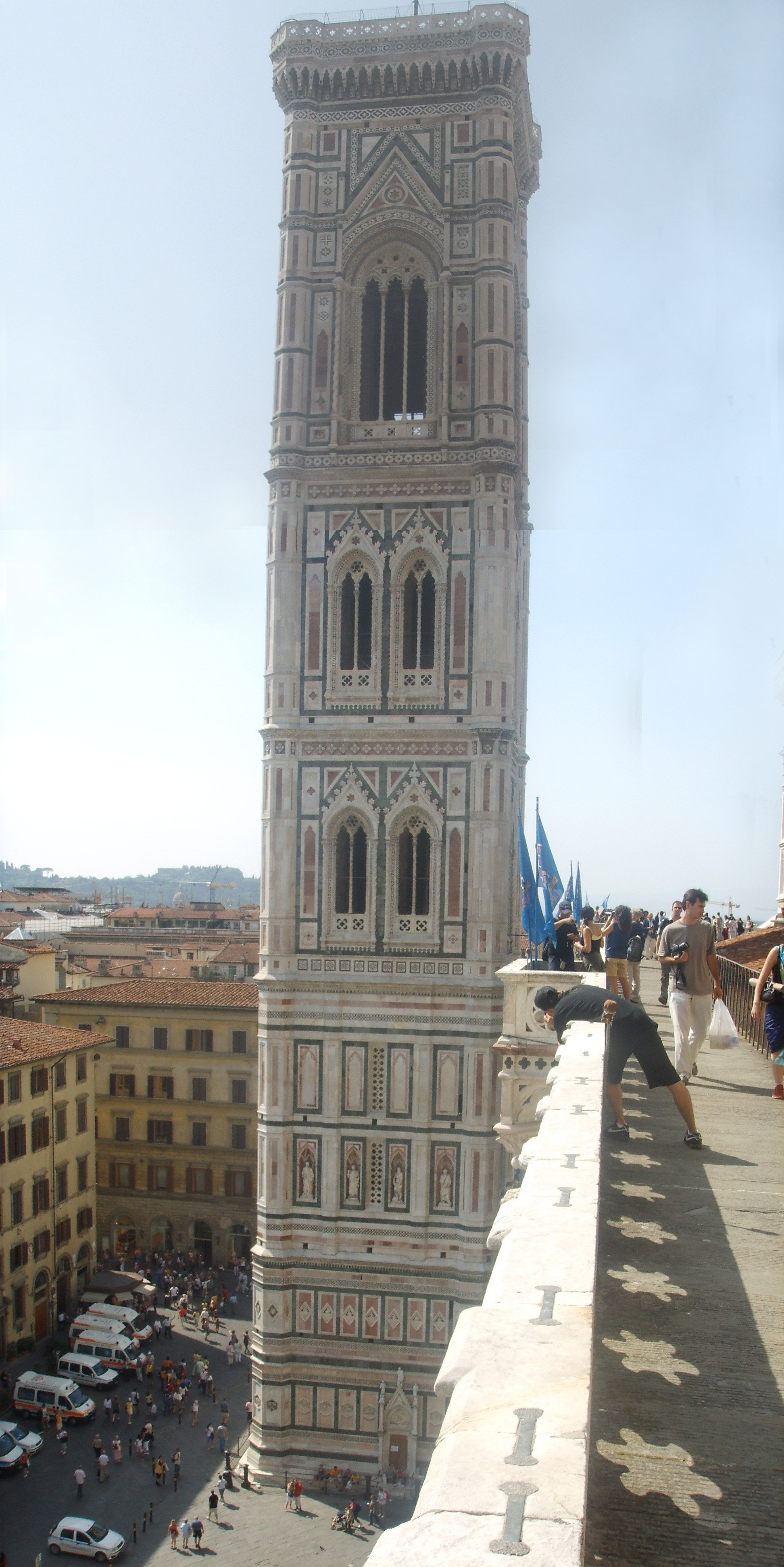
Giotto's Campanile, begun in 1334 and largely completed by Francesco Talenti by 1359, established the Florentine model for bell tower architecture. Unlike the brick towers of Lombardy, the Florentine campanile uses marble cladding — green Prato marble, white Carrara marble, and pink Maremma marble — applied over a structural masonry core. The polychrome surface decoration is geometric, composed of inlaid marble panels in repeating rhombus and square patterns, a technique derived from the opus sectile tradition that also appears on the Florence Baptistery.
The tower rises 84.7 metres in four main stages, each articulated by deep string courses and canopied niches that originally held sculptural reliefs (now replaced by casts, with the originals held in the Museo dell'Opera del Duomo). The belfry zone opens through two tiers of biforate windows before reaching the narrow top cornice.
No other major Tuscan campanile directly replicated the Florentine polychrome model, though the influence of the proportional system — the deliberate progression from solid base to increasingly fenestrated upper stages — can be traced in later Tuscan campanile construction.
Venetian campanili: brick shafts on timber piling
Venice's towers occupy a structurally distinct category. The absence of load-bearing stone foundations in the Venetian lagoon meant that campanili were built on dense assemblies of timber piling driven into the underlying sediment, with a broad brick plinth above. The towers are characteristically tall and slender relative to their base dimensions, a proportion partly necessitated by the foundation constraints.
The Campanile di San Marco, the most prominent example, rises 98.6 metres and is built almost entirely in plain brick with stone dressings at the belfry and loggia levels. It collapsed in 1902 — not from external event but from the slow weakening of the internal masonry — and was rebuilt to the same design by 1912. The rebuilt tower's foundations use reinforced concrete rather than timber, though the upper structure is a faithful reconstruction.

Foundation settlement and tower inclination
Several Venetian campanili show measurable inclination resulting from differential settlement of their timber-pile foundations. The campanile of San Pietro di Castello leans visibly. This is not an isolated phenomenon — across Venice, the combination of variable sediment layers, uneven loading, and the long-term decay of organic piling material produces gradual tilt in many structures. The rate of inclination in most cases is slow enough to be managed through periodic structural intervention rather than requiring demolition.
Southern campanili: Norman and Byzantine influences
In Sicily and Campania, campanile architecture reflects the Norman and Byzantine building traditions that shaped church construction in the south during the eleventh through thirteenth centuries. The campanile of the Palermo Cathedral and towers associated with Norman-era churches in Cefalù and Monreale use interlaced blind arcading and geometric surface patterns derived from Arabic and Byzantine decorative traditions, producing forms with no direct counterpart in the northern Italian corpus.
Structural components common across regional types
Despite regional variation, the structural organisation of Italian campanili follows a broadly consistent logic: a solid or near-solid base zone providing the mass needed to resist lateral forces; a shaft rising through multiple stages with progressively more window openings; and a belfry level with full open arches or louver openings to allow sound to project outward. The transition between shaft and belfry is typically marked by a more emphatic string course or by a change in surface material or treatment.
Internal access is via spiral or straight staircase within the tower walls or, in smaller towers, via ladders. The mechanism for hanging and operating the bells — whether swinging, quarter-swinging, or fixed with external clappers — was adapted to the space available in the belfry and to the local ringing tradition.